 Destination Guides
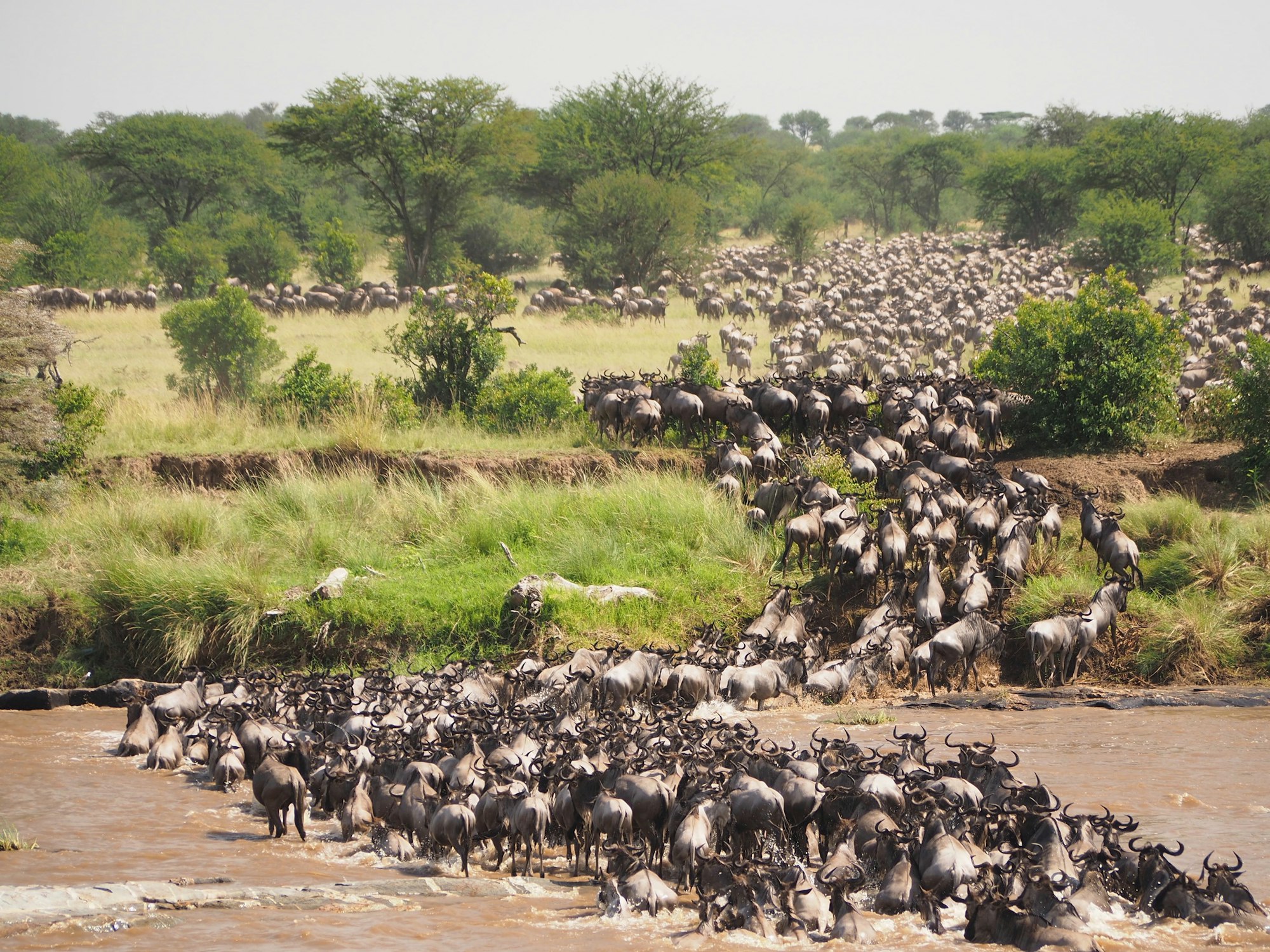
Each year, well over a million wildebeest, together with hundreds of thousands of zebras and gazelles, move in a slow loop through the Serengeti ecosystem and into Kenya’s Maasai Mara. They follow the rain and the fresh grass that comes after it. This movement is the Great Migration, and seeing it is the reason many travellers come to Tanzania.
The herds do not keep to a fixed calendar. An early or late rainy season can shift them by several weeks, and they spread across a huge area rather than moving in one column. What follows is the general pattern our guides work with, month by month.
How the migration works
The herds spend most of the year in Tanzania. They calve on the southern Serengeti plains early in the year, move north-west as the plains dry out, cross into the far north of the Serengeti and the Maasai Mara for the driest months, then return south when the short rains begin. Predators follow them the whole way, and crocodiles wait at the rivers.
The migration month by month
January to March: calving in the southern Serengeti and Ndutu
The herds gather on the short-grass plains around Ndutu, on the border of the Serengeti and the Ngorongoro Conservation Area. The grass here grows on volcanic soil rich in minerals, which suits nursing mothers. Most calves are born within a few weeks, usually peaking in February. Lions, cheetahs and hyenas hunt across the open plains, so this is one of the best times of year for predator sightings.
April and May: moving through the central Serengeti
As the long rains fall and the southern plains are grazed down, the herds start moving north and west through the central Serengeti. You may see long lines of wildebeest crossing the plains. It is the quietest time in the park, with few other vehicles and lower lodge rates.
June and July: the Western Corridor and the Grumeti River
By June, large groups reach the Western Corridor, a strip of the park that runs towards Lake Victoria. Here they must cross the Grumeti River, home to some very large crocodiles. Crossings here are less predictable than on the Mara River, but the area is quieter.
July to October: the northern Serengeti and the Mara River
This is the period of the famous river crossings. The herds move into the northern Serengeti and back and forth across the Mara River, sometimes several times. A crossing can happen within minutes, or a herd can gather on the bank for hours and then turn away. Patience, and time in the area, makes the difference. We recommend at least two or three nights in the north if crossings are your priority.
November and December: heading south again
When the short rains arrive, the herds leave the north and travel down the eastern side of the Serengeti towards the southern plains, ready for calving to begin again. Sightings are scattered but often uncrowded, and the landscape turns green.
Tips for seeing the migration
- Choose your base by month. The Serengeti covers more than 14,000 square kilometres. Staying in the right area saves hours of driving.
- Allow enough nights. Two nights in the Serengeti is the minimum; three or more gives you a far better chance of good sightings.
- Keep expectations flexible. River crossings are never guaranteed. The calving season is the most reliable time to see huge numbers of animals in one place.
- Travel in a private vehicle. Waiting at a river crossing can take hours. With your own vehicle and guide, you decide how long to stay.
- Bring binoculars. Herds often stretch to the horizon, and much of the action happens at a distance.
Which safari fits the migration?
Our 7-Day Tanzania Safari and 8-Day Luxury Tanzania Safari give you enough time in the Serengeti to follow the herds, and our 13-Day Tanzania and Zanzibar Safari adds a beach finish. As every trip is private, we can adjust where you stay in the Serengeti to match the month you travel.
If you are not sure which season to choose, read our guide to the best time to visit Tanzania, or tell us your dates and we will tell you where the herds are likely to be.